

It’s 9 PM, snow is falling, and you’re refreshing two different apps on your phone one telling you there’s an 80% chance school gets canceled, the other just showing a forecast of “3-5 inches, breezy.” So which one do you actually listen to? This is the exact confusion behind the snow day calculator vs weather app debate, and it trips up parents, students, and even teachers every winter. A standard weather app tells you what the sky is going to do. A snow day calculator, sometimes called a snow day calc tries to go a step further and tell you what your district is going to do about it. Those are two very different jobs, and conflating them is where most of the frustration comes from.
What Is a Snow Day Calculator vs Weather App Comparison Really About?
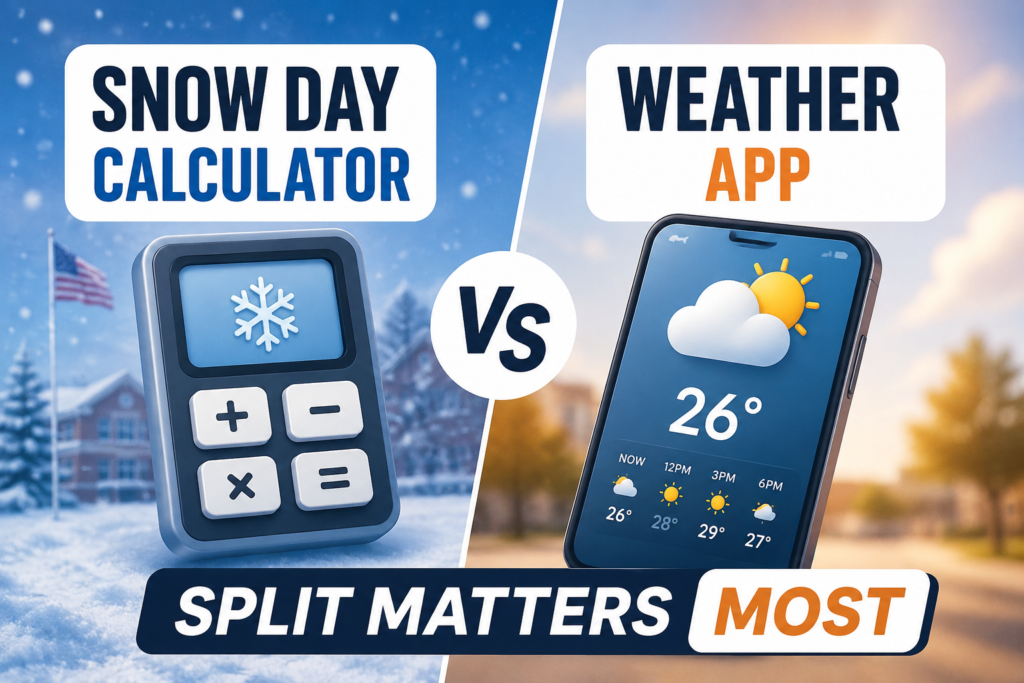
At their core, these two tools are answering different questions. A weather app answers: “What will the atmosphere do?” A snow day calculator answers the question: “What will my school district likely decide because of what the atmosphere does?”
A typical weather app thinks your phone’s built-in forecast or a service like a national meteorological site pulls data from radar, satellites, and forecast models. It gives you temperature, precipitation type, snowfall totals, wind speed, and timing. That’s genuinely useful information, but it stops there. It has no idea who your superintendent is, how your district has handled snow in the past, or whether your buses can handle icy back roads.
A snow day predictor, by contrast, layers decision-making logic on top of that same weather data. It typically factors in things like:
- Historical closure patterns for your specific school district
- Road conditions and local infrastructure (rural districts with long bus routes behave differently than dense urban ones)
- Timing of the storm (a Tuesday morning surprise hits differently than a storm that’s been forecast for a week)
- District-specific tendencies (some superintendents lean cautious, others rarely cancel)
This is essentially trying to function as a school closure predictor modeling the human decision, not just the weather event. That’s a much harder problem than forecasting snowfall, which is part of why these tools can feel hit-or-miss.
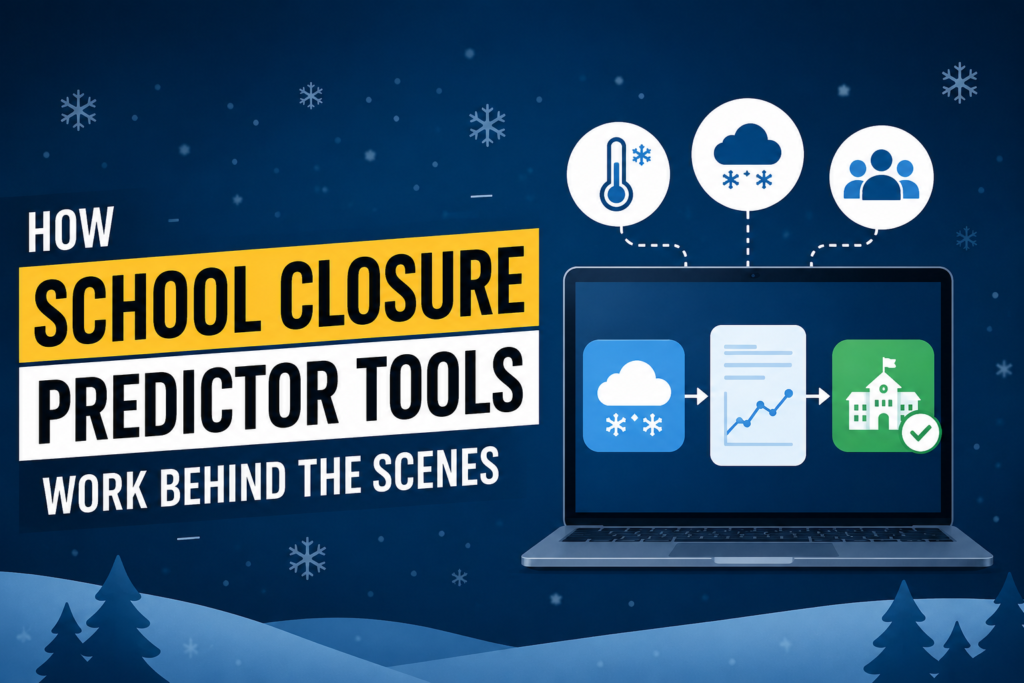
How School Closure Predictor Tools Work Behind the Scenes
Most closure predictors are built by combining public weather data with crowd-sourced or historical closure records. Some sites let users report actual outcomes (“my district called it, mine didn’t”), and the tool uses that feedback to refine future predictions. Others rely more heavily on pattern-matching against years of past closure decisions in a given county or state.
The honest answer is that no tool has access to the actual meeting where your superintendent makes the call. They’re modeling probability, not reading minds. That’s why you’ll often see predictions phrased as percentages (“65% chance of closure”) rather than a flat yes or no it’s an acknowledgment of real uncertainty, not just hedging.
Snow Day Calculator vs Weather App: Why Accuracy Varies by Region
Snow day predictor accuracy isn’t uniform across the map, and this is one of the most important things to understand before trusting any single number.
- Rural districts with long, hilly bus routes tend to close more readily for modest snowfall than tightly packed urban districts with short walking routes.
- Southern U.S. states and parts of the UK that rarely see snow often close schools for amounts that a Canadian or northern U.S. district would consider a non-event, simply because road crews and drivers have less experience with icy conditions.
- Snow day prediction models trained mostly on U.S. data may underperform for Canadian or UK users, where terminology (e.g., “inset days” in the UK) and closure norms differ.
This regional variation is exactly why a snow day predictor should be treated as a probability estimate, not a guarantee the same storm can mean a canceled day in one town and a normal Tuesday twenty miles away.
Snow Day Calculator vs Weather App: Accuracy, Data Sources, and Real-World Limits
A weather app’s accuracy is a science problem measured in inches, degrees, and timing windows, and it improves with better satellite and radar tech. A snow day calculator’s accuracy is a human behavior problem, which is inherently messier. No amount of better weather data can fully predict a nervous superintendent’s 5 AM decision.
When a Snow Day Calculator vs Weather App Split Matters Most
The gap between the two shows up most during borderline storms 2 to 4 inches, arriving overnight, with icy road potential. Here, a snow predictor might lean toward “likely closure” based on district history, while the weather app simply shows a modest snowfall total with no context. In these marginal cases, treat the snow day calc as a probability nudge, not a verdict the weather app gives you the raw facts, the calculator gives you an educated guess layered on top.
Which One Should You Actually Trust?
The smartest approach isn’t choosing one tool over the other it’s using both. Check the weather app for the raw forecast (snowfall totals, timing, wind), then check a snow day calculator vs weather app style predictor for the probability estimate based on your specific district’s history. Together, they give you the full picture instead of half of it.
Frequently Asked Questions
Is a snow day calculator ever more reliable than checking the weather directly?
Not more reliable for the weather itself but it adds context a plain forecast can’t, since it factors in your district’s actual closure patterns.
Why do two neighboring districts get different snow day predictions?
Local infrastructure, bus routes, and each superintendent’s historical tendency to close early or push through minor storms all vary block by block.
Should I skip packing my kid’s bag based on a prediction?
No. Treat any prediction as a probability, not a confirmation. Always wait for the official district announcement before making plans.