It’s 9 PM, snow is in the forecast, and you’re refreshing a website hoping it’ll tell you what your school district hasn’t decided yet. That’s the whole appeal and the whole problem of a snow day predictor. These tools promise a number, a clean percentage that feels like certainty. But how much should you actually trust it? The short answer: it depends on timing, your location, and how honest you are about what these tools can and can’t see. Before you plan around a score, it helps to understand where that number comes from and where it tends to fall apart.
What a Snow Day Predictor Actually Measures
A snow day calculator doesn’t guess out of thin air it runs a handful of real inputs through a scoring model. Most tools pull in forecasted snowfall totals, the timing of the storm (an overnight dump behaves very differently than snow that starts during the morning commute), temperature, wind chill, and road conditions. Many also factor in your district’s own closure history, since a town that’s closed schools for 2 inches before is more likely to close again than one that plows through a foot without blinking.
The output is a single number a snow day prediction expressed as a percentage. It feels precise, but true snow day predictor accuracy depends on how well that pattern-matching reflects your specific district, not just a generic probability estimate. That distinction matters more than most tools admit, and it’s the first thing worth understanding before you check tomorrow’s score.
Snow Day Predictor Accuracy: What the Numbers Actually Say
Most calculators advertise snow day predictor accuracy somewhere between 80% and 90%, especially in the final 24 hours before a storm hits. That number isn’t fabricated short-range snowfall forecasts genuinely are reliable that close to an event, since meteorologists have less time for conditions to shift.
But here’s what most of these sites don’t tell you: that accuracy figure is self-reported by the tool’s own creators. There’s no independent third party auditing these claims the way there is for, say, a hurricane forecast model. So when a site says its snow predictor is “wickedly accurate” or hits 85%, treat that as marketing language backed by some data not a peer-reviewed statistic.
Short-Term vs. Long-Term Snow Day Predictor Accuracy
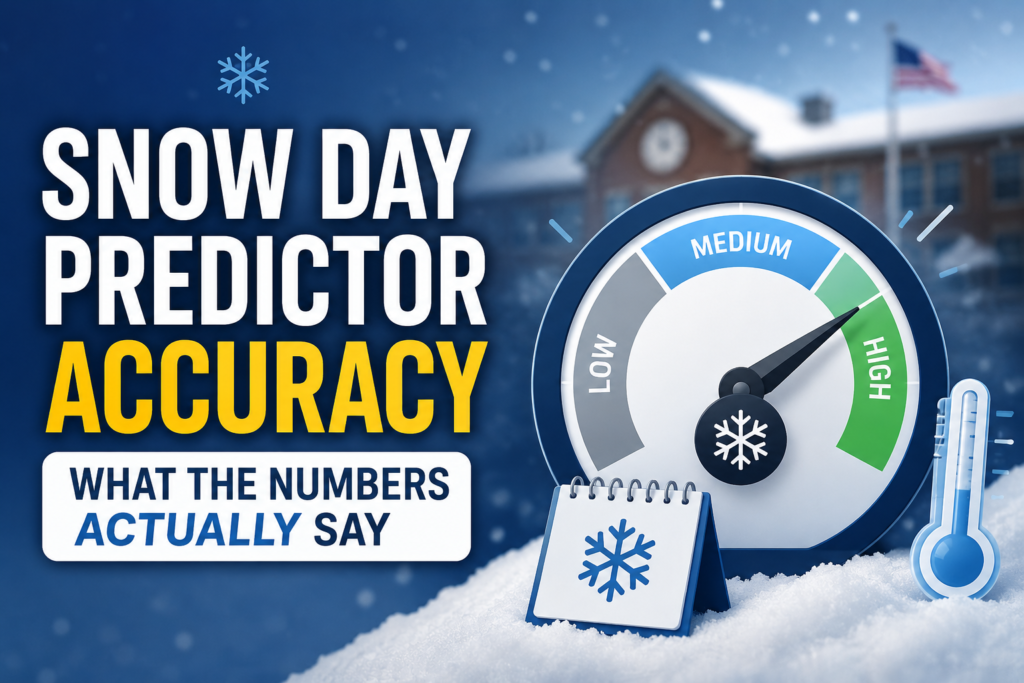
Accuracy isn’t a fixed number it moves with the calendar. A prediction made the night before or the morning of a storm can be genuinely useful, since it’s built on forecasts that are usually within a few hours or a few inches of reality. A prediction made five or seven days out is a different animal entirely. At that range, meteorologists themselves are working with wide error bars, so any snow day calc showing a confident percentage a week ahead is really just extrapolating from a shaky forecast.
Why Predictions Miss: The Human Factor Behind Every Snow Day Prediction
Here’s the part almost no calculator website explains clearly: even a perfect weather forecast doesn’t guarantee a perfect snow day prediction, because school closures aren’t purely weather decisions. They’re human decisions, made by superintendents weighing things no algorithm can see, whether buses can safely reach rural routes, whether the district’s parking lots got plowed in time, whether a heating system is acting up, or whether nearby districts have already announced closures (a real factor, since administrators often watch each other).
This is exactly why snow day predictor accuracy breaks down in individual cases — you’ll sometimes see a snow day predictor show 70% and school stays open, or show 30% and school closes anyway. The tool isn’t broken; it simply can’t model a superintendent’s 5 AM phone call with the transportation department.
Regional Thresholds: Why Texas ≠ Minnesota
How accurate is snow day calculator performance also depends heavily on where you live, because “enough snow to close school” is not a fixed amount. A district in Texas or the Carolinas might shut down over an inch of snow and some ice, since they lack the plows, salt trucks, and winter tires that northern towns take for granted. Meanwhile, a district in Minnesota, Quebec, or upstate New York might stay open through 8 inches, because the infrastructure and staff are built for it.
A calculator that doesn’t weight your specific district’s historical closure threshold is essentially guessing at a national average which is a big reason accuracy varies so much from one prediction to the next.
Snow Day Calculator Accuracy in the US, Canada, and the UK
Snow day predictor accuracy also shifts depending on which country you’re in, and this is a detail most articles skip entirely.
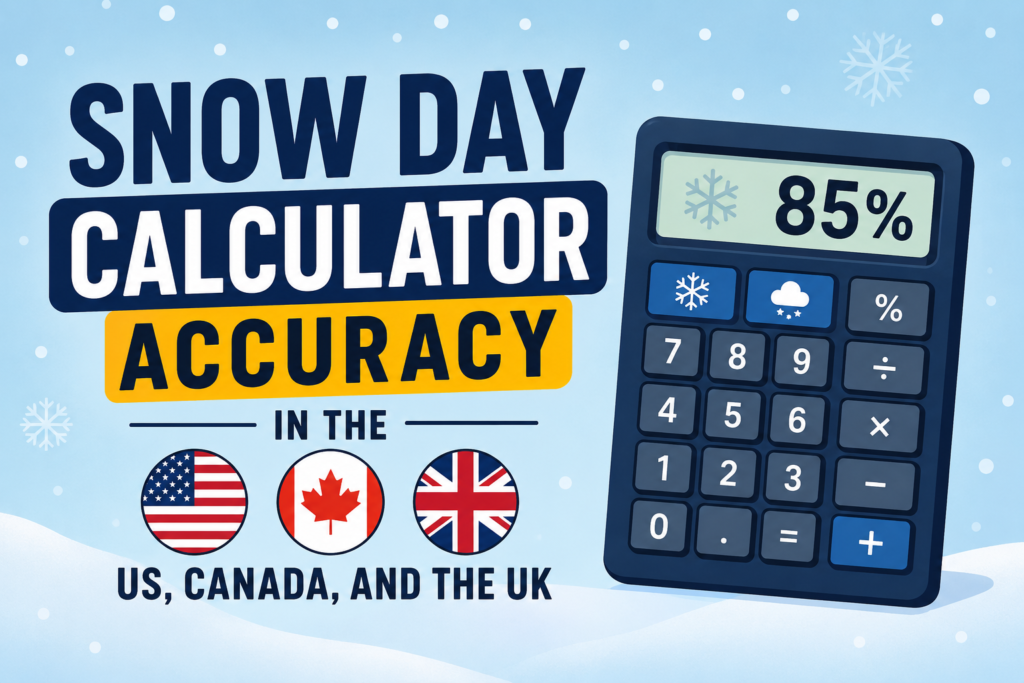
In the US, especially the Midwest, Northeast, and Great Lakes region, these tools have the most data to work with decades of closure history, consistent winter weather patterns, and enough user reports to refine local predictions over time. This is where snow day predictor accuracy tends to be strongest.
In Canada, the tools work on similar logic, but with a twist: many Canadian districts have higher snow tolerance than their US counterparts, plus added factors like extreme cold warnings that can close schools even without heavy snowfall. A calculator that only weighs snow totals and ignores wind chill and cold-related closures will underperform in Canadian provinces like Ontario or Quebec.
In the UK, snow day predictors are far less reliable, mainly because UK schools rarely close for snow in the first place, and closures that do happen are often hyperlocal a handful of schools in one county while everywhere else stays open. Fewer closures over the years means less historical data to train a prediction on, so UK users should treat these percentages as rough guesses at best, not calibrated forecasts.
How to Use a Snow Day Prediction Wisely
So where does this leave you? Treat a snow day predictor as a well-informed guess, not a guarantee. The tools are genuinely useful for gauging likelihood especially within 24 hours of a storm but they can’t replace the actual announcement from your school district.
A few practical habits make these tools more useful:
- Check close to the event. A prediction made the morning of a storm is far more trustworthy than one made a week out this is where real snow day predictor accuracy shows up.
- Know your district’s history. If your area has closed for less snow before, weigh the score higher; if it rarely closes, be skeptical even of a high percentage.
- Watch official channels too. District websites, robocalls, and local news alerts still make the final call the calculator is a heads-up, not a decision-maker.
- Don’t skip safety basics. Regardless of what any score says, if roads are icy or wind chill is dangerous, treat the morning commute with caution and follow local travel advisories.
Used this way, a snow day predictor accuracy isn’t about chasing a perfect number it’s about reading probability correctly, understanding your region’s quirks, and knowing that the final word always belongs to the people who actually run your school.
FAQs
How accurate is a snow day calculator within 24 hours of a storm?
Most tools perform best in this window, often landing in the 80–90% range, since short-term snowfall forecasts are far more reliable than long-range ones.
Why did the snow day predictor say high odds, but school stayed open?
Closures depend on more than weather road conditions, staffing, and district-specific thresholds all play a role that a calculator can’t fully see.
Is snow day predictor accuracy the same everywhere?
No. Districts in snow-heavy regions like Minnesota or Quebec have higher closure thresholds than places like Texas or the UK, so the same forecast can produce very different real-world outcomes.
Do these calculators work well in Canada and the UK?
They work reasonably well in Canada, especially when wind chill is factored in, but they’re far less reliable in the UK, where snow closures are rare and hyperlocal.
Should I make plans based on a snow day prediction alone?
Treat it as a helpful estimate, not a final answer always confirm with your school district’s official closure announcement before finalizing plans.