

If you’ve ever refreshed your phone at 10 PM hoping to see a closure alert, you already know the anxious math of winter mornings. But lately, more parents and students are noticing a new term pop up alongside the usual one: districts are calling ice days instead of snow days sometimes with barely any snow on the ground at all. So what actually separates an ice day vs snow day, and why does it matter for predicting tomorrow’s outcome?
The short answer: they’re triggered by completely different hazards. A snow day is about accumulation and visibility. An ice day is about surface friction literally, whether tires and feet can grip the ground at all. Understanding that difference is the key to reading forecasts correctly and getting more accurate results from any snow day calculator or snow day predictor you’re using.
What Is a Snow Day, Exactly?
A snow day is the closure most people grew up with: heavy or steadily falling snow accumulates faster than plows and buses can safely manage. Superintendents weigh total inches, how fast it’s falling, and whether it’ll clear before the morning bell. In much of the US Midwest and Northeast, or across snow-belt regions of Canada, a few inches barely register but the same snowfall in Georgia or southern England can shut everything down, because the equipment and driver experience simply aren’t there to handle it.

What Is an Ice Day: And Why It’s Not the Same Thing
An ice day is triggered by a completely different hazard: freezing rain, sleet, or refreezing meltwater that turns roads, sidewalks, and bus steps into sheet ice. This is why the ice day vs snow day distinction matters so much to school administrators: the same storm can require a totally different response depending on which one is falling.
Here’s the part that surprises a lot of parents: freezing rain school closure decisions often happen with far less precipitation on the ground than a typical snow closure. A dusting of ice can be more dangerous than six inches of snow, because ice doesn’t just sit on the surface it bonds to it.
Why Freezing Rain School Closures Happen With Little or No Snow
Snow can be plowed, brushed, and shoveled. Ice can’t be moved; it has to be treated with salt or sand and given time to break down, and even then, it can refreeze overnight as temperatures drop again. That’s why a district might stay open through a moderate snowstorm but close entirely for what looks, on paper, like a minor weather event. This gap is really at the heart of the ice day vs snow day debate: two storms that look similar on paper can lead to opposite decisions. If overnight temperatures hover right around freezing, treated roads can look clear at 9 PM and turn into a skating rink by 6 AM. Bus companies and administrators know this pattern well, which is why ice related closures are often called earlier and more cautiously than snow closures; it’s better to cancel the night before than risk a bus sliding on black ice at dawn.
Ice Day vs Snow Day: Side-by-Side Comparison
Once you separate the two, the pattern becomes easy to spot in real forecasts:
- Snow day trigger: Heavy accumulation, low visibility, overnight snowfall that piles up before plows can clear routes.
- Ice day trigger: Freezing rain, sleet, or a refreeze cycle that glazes roads and walkways often with a fraction of an inch of precipitation.
- Snow day response: Plows run overnight; decision often comes early morning once accumulation totals are clearer.
- Ice day response: Decisions tend to come the night before, since ice risk is harder to reverse once it sets in.
This is exactly why a straight snow day calculator and a dedicated ice day calculator don’t always agree one is weighing snowfall totals and wind, the other is weighing surface temperature and refreeze timing. A good snow day prediction tool for a winter storm mixing both hazards needs to account for both models at once, not just snowfall depth.
Regional Differences: USA, Canada, and the UK
In the US and Canada, “snow day” is practically a cultural institution; kids grow up watching local news for the crawl at the bottom of the screen. Ice days are treated as their own, more urgent category, especially in the Midwest, Ontario, and Quebec, where refreeze cycles are common through winter.
The UK works differently, and it’s a good example of how the ice day vs snow day framing shifts by country. British schools rarely use the term “ice day” at all; closures are instead framed around Met Office ice and snow warnings, and the decision usually comes down to whether the school site itself is safe to walk on, not a broader cultural “snow day” tradition. If you’re searching from the UK, you’re more likely to see the term freezing rain school closure used by local authorities than “ice day.”
How a Snow Day Calculator or Ice Day Calculator Predicts Closures
Most tools marketed as a snow predictor pull the same base ingredients: forecasted accumulation, temperature trends, wind speed, and timing relative to the morning commute. But the tools that actually perform well during mixed winter storms weight those ingredients differently depending on which hazard is dominant. For a snow-driven forecast, a snow day calc leans heavily on total accumulation, snowfall rate, and whether the bulk of it falls before or during morning bus routes. For an ice-driven forecast, the same tool needs to shift its weighting toward surface temperature, dew point, and whether overnight refreeze is likely because, as covered earlier, a thin glaze of ice can outrank several inches of snow in closure probability.
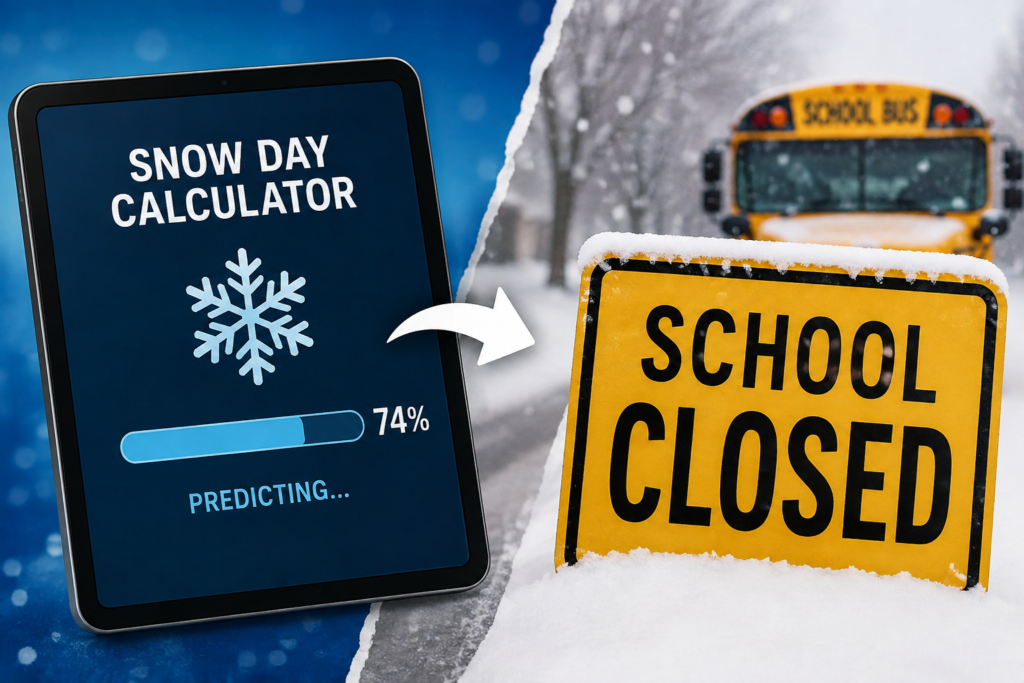
This is the real value of understanding the ice day vs snow day distinction before you check a calculator: it tells you which numbers to actually pay attention to. If freezing rain is in the forecast, don’t fixate on the snowfall total watch the overnight low and whether temperatures are expected to hover right at the freezing line. If it’s a straightforward snowstorm, accumulation and timing tell you almost everything you need to know. One practical habit worth building: check your local snow day predictor again right before bed rather than relying on an afternoon forecast. Ice and snow systems shift quickly overnight, and a forecast that looked mild at 6 PM can look very different by midnight which is exactly when most district decisions actually get made.
FAQs
Is an ice day the same as a snow day?
No. A snow day is called for heavy accumulation and low visibility, while an ice day is called for freezing rain, sleet, or refreeze conditions that make surfaces dangerously slick often with very little precipitation on the ground.
Why did my school close for ice but stay open during a bigger snowstorm?
Because ice is harder to treat and reverse than snow. Plows can clear snow in hours; ice often needs salt, sand, and time and can refreeze overnight even after treatment, which is why administrators tend to close early for ice rather than wait and see.
Can freezing rain cause a school closure with zero snowfall?
Yes. A freezing rain school closure can happen with no snow at all, since the danger comes from ice bonding to roads and walkways, not from accumulation.
How accurate is a snow day calculator or ice day calculator?
Most tools are reasonably reliable 12–24 hours out, but accuracy drops for storms further in advance, especially mixed events where temperatures hover near freezing. Checking again closer to bedtime, when overnight temperature trends are clearer, gives a more reliable read than an afternoon forecast.
Do UK schools call them “ice days”?
Rarely. UK closures are typically framed around Met Office snow and ice warnings and whether the school site itself is safe, rather than the “snow day” or “ice day” terminology common in the US and Canada.
What matters more for closures: snowfall totals or ice risk?
It depends on the storm. For pure snow events, accumulation and timing dominate. For mixed or ice-heavy systems, surface temperature and refreeze timing matter more than how much precipitation actually falls which is the core of the ice day vs snow day decision districts face all winter.