

If you’ve ever watched a Southern school district shut down over an inch of snow while a friend up North sends you a photo of kids trudging through two feet of it to catch the bus, you’ve probably wondered the same thing millions of parents type into Google every winter: why do southern schools close for snow when it seems like such a small amount compared to what other regions handle without blinking?
The honest answer isn’t that Southern kids “can’t handle snow” or that districts are overreacting. It comes down to infrastructure, road chemistry, and a type of winter weather that’s far more dangerous than snow itself. Once you understand what’s actually happening on the ground, the decision makes a lot more sense.
It’s Not About the Snow: It’s About the Ice
Ask any transportation director in Georgia, Texas, or the Carolinas why schools shut down for what looks like a light dusting, and you’ll get the same answer almost every time: it’s rarely the snow that’s the problem it’s the ice hiding underneath it or forming right after it, which is one of the biggest reasons why do southern schools close for snow so much faster than other regions.
In much of the South, ground and pavement temperatures hover right around freezing rather than staying reliably below it like they do up North. That narrow margin means precipitation often falls as a mix snow, sleet, and freezing rain and refreezes overnight into black ice that’s nearly invisible on roads and sidewalks. A single icy patch on a two-lane rural road is a much bigger hazard than several inches of dry, powdery snow that a well-equipped Northern city handles daily.
Why Southern Roads Turn Dangerous So Fast
Southern roads also lack the friction-improving treatments Northern states apply before storms even arrive. Without pre-treatment, a light snow event can bond directly to warm asphalt, melt slightly during the day, and refreeze into a sheet of ice by the time buses run the next morning turning a seemingly minor storm into a serious safety risk almost overnight.
Southern States Snow Closures vs. Northern Snow Days
The gap between southern states snow closures and Northern school schedules isn’t random. It’s the direct result of decades of infrastructure decisions that made sense for each region’s actual weather patterns. Northern states like Minnesota, Michigan, and New York invest heavily in snowplow fleets, road salt stockpiles, and driver training because they face dozens of snow events every single winter. That spending is justified because it gets used constantly. Southern states, by contrast, might see one or two winter weather events a year. Buying and maintaining a full plow fleet for a storm that hits once every twelve months simply isn’t a reasonable use of a county’s budget, so most Southern districts don’t have that equipment at all.
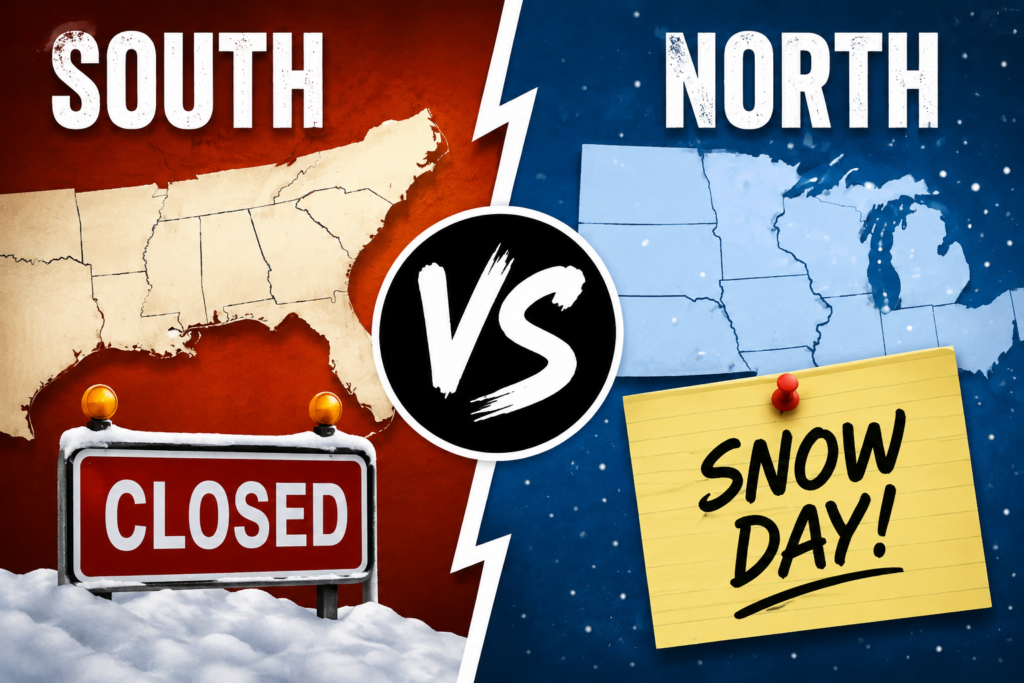
Regional Snow Day Differences by Infrastructure Investment
These snow day regional differences show up clearly when you compare closure thresholds. A half inch of snow can shut down schools in Atlanta or Charlotte, while the same amount barely registers in Chicago or Buffalo. It isn’t inconsistency. It’s two regions making rational choices based on how often they actually deal with winter weather and what equipment they have on hand to respond to it.
Who Actually Decides to Close Schools for Snow?
The decision to close a school district rarely comes down to one person making a gut call at 5 a.m. Most districts follow a structured process involving several people who each check a different piece of the puzzle.
Transportation directors are usually the first to weigh in, since they’re the ones who send staff out before dawn to drive actual bus routes and see road conditions firsthand. Superintendents rely on that on the ground feedback, combined with forecasts from the National Weather Service and sometimes private meteorology services, before making a final call. In many counties, law enforcement or the department of transportation also provides input, especially when rural roads or bridges are involved, since those tend to ice over before major roads do.
This is also why closures can vary so much between neighboring counties even during the same storm, and it’s part of the answer to why do southern schools close for snow in one county while a district just next door stays open. A district with hilly terrain, older buses, or a lot of rural bus routes will close far more readily than a neighboring district with flatter roads and shorter routes, even if both districts see the same snowfall total. The decision genuinely reflects local conditions, not just a blanket regional overreaction to winter weather.
Snow Day Calculators and Predictors: How Reliable Are They?
Once a storm is in the forecast, plenty of parents turn straight to a snow day calculator or snow day predictor to see if tomorrow is likely to be called off. These tools are fun, and they can be a reasonably useful starting point, but they come with a real limitation that’s rarely mentioned: most were built and trained primarily on Northern closure patterns.
A typical snow predictor looks at expected snowfall totals, temperature, and wind to estimate closure odds. That works fairly well in regions where snow accumulation is the main driver of a closure. But as covered earlier, Southern closures are just as often triggered by ice and freezing rain as by snow itself, which is exactly why why do southern schools close for snow can be hard to predict using tools built for Northern weather patterns. A snow day prediction tool that weighs snowfall heavily can easily underestimate closure odds in the South during an ice heavy event, or overestimate them during a dry, low ice snow event that a district can actually manage.
That doesn’t mean these tools are useless. A snow day calc can still give you a decent general sense of how serious a storm looks. Just treat it as one input rather than the final word, especially in the South. Your district’s own alerts and local news forecasts, which typically build in adjustments for road temperature and ice risk, are still the most reliable source once a storm is actually approaching.

Final Thoughts
At the end of the day, Southern school closures aren’t about overreacting to a little snow. They come down to road chemistry, limited winter-weather equipment, and the real danger of ice on roads that were never built or treated to handle it. Once you understand the infrastructure and safety reasoning behind it, why do southern schools close for snow so quickly stops feeling like an overreaction and starts making complete sense.
Frequently Asked Questions
Why do southern schools close for snow when it’s only an inch or two?
Because Southern roads lack the plows, salt, and pre-treatment systems that Northern states rely on, even a small amount of snow can quickly turn into a sheet of ice. That’s the core reason why do southern schools close for snow far more readily than districts up North.
Is it really about safety, or are Southern schools overreacting?
It’s genuinely about safety. Districts that don’t own snowplows or have drivers trained for icy roads face real risk if they try to run buses through even a light storm. This is one of the most misunderstood parts of why do southern schools close for snow so quickly compared to other regions.
Do all southern states close schools the same way for snow?
No. Closure thresholds vary by county based on terrain, road quality, and how rural the bus routes are. That’s part of why why do southern schools close for snow doesn’t have a single, one-size-fits-all answer, even within the same state.
Are snow day predictors accurate for southern states?
They’re a helpful starting point, but many are built around Northern snowfall patterns rather than Southern ice risk, so they can be less accurate here. Understanding why do southern schools close for snow in your specific area still comes down to local road and ice conditions more than snow totals alone.