
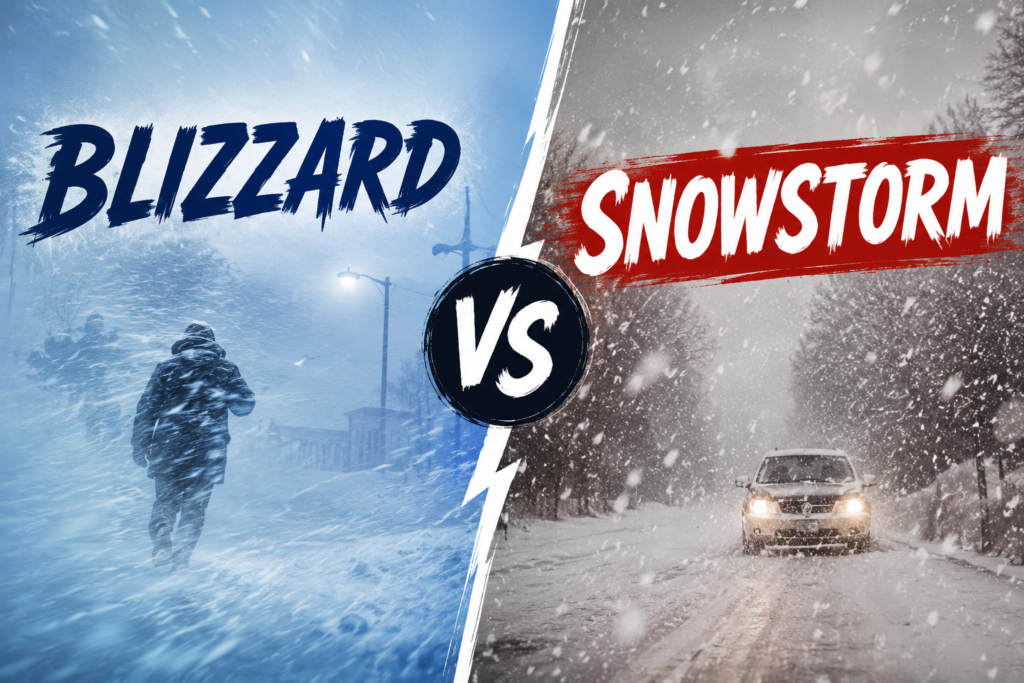
When the forecast turns white and the wind picks up, most people use “blizzard” and “snowstorm” as if they mean the same thing. They don’t. The blizzard vs snowstorm debate isn’t just semantics it’s the difference between a messy commute and a genuinely dangerous one. Meteorologists in the US, Canada, and the UK all draw a hard line between the two, and knowing which side of that line a storm falls on can change how you plan your day, your drive, and even whether school gets cancelled.
What Is a Snowstorm?
Here’s the part that surprises people: “snowstorm” isn’t actually an official scientific term. It’s just a general, everyday word for any storm system that produces snow heavy or light, windy or calm. A snowstorm might drop eight inches overnight in dead-still air, or it might be barely more than a flurry. There’s no wind requirement, no visibility threshold, and no minimum duration. That’s exactly what separates it from the next category, because once wind and visibility get involved, a plain snowstorm can cross into much more serious territory which is where the real blizzard vs snowstorm distinction begins.
What Officially Makes a Blizzard a Blizzard?
A blizzard is where things get technical. Unlike “snowstorm,” the word “blizzard” has a strict legal definition set by the National Weather Service, and a storm doesn’t earn that label just because it looks intense from your window. It has to hit three specific benchmarks at the same time. Understanding this is the fastest way to settle the blizzard vs snowstorm question the next time a news anchor throws the word around loosely.
The Three-Part NWS Criteria
According to the National Weather Service, a storm only qualifies as an official blizzard when all three of these conditions happen together:
- Sustained winds or frequent gusts of at least 35 mph
- Visibility reduced to less than a quarter mile because of falling or blowing snow
- These conditions lasting for three consecutive hours or longer
Notice what’s missing from that list: total snowfall and temperature. A storm can dump two feet of snow and still not be a blizzard if the wind never picks up. Meanwhile, a storm with modest snowfall but howling wind absolutely can be. The blizzard vs snowstorm difference really comes down to wind and visibility working together, not how much snow lands on the ground.
Ground Blizzards: No New Snow Required
Here’s the detail most people never expect: a blizzard doesn’t need a single new flake falling from the sky. If strong wind picks up snow that already fell days ago and blows it around hard enough to meet the same wind and visibility thresholds, that’s called a ground blizzard. Picture a clear, sunny sky with 40 mph wind sweeping loose snow across an open field until you can’t see the road in front of you. Meteorologically, that counts exactly the same as a storm actively dumping snow. It’s a detail that trips up a lot of drivers who assume “no snow falling” means “safe to go.”
Blizzard vs Snowstorm: US, Canada & UK Compared
The National Weather Service’s rules aren’t universal, and this is where the blizzard vs snowstorm conversation gets more interesting for readers outside the US.
In the United States, the criteria are fixed and numeric: winds of 35 mph or greater, visibility under a quarter mile, sustained for three hours.
Canada uses a similar framework, but with a longer time requirement. Environment Canada defines a blizzard as winds strong enough to cause blowing or falling snow that cuts visibility down significantly, persisting for at least four hours. In the far north, above the arctic tree line, that duration requirement stretches to six hours, since brief wind gusts are far more common there and don’t automatically signal a dangerous system.
The UK takes a noticeably different approach. The Met Office doesn’t publish a single fixed wind speed or duration threshold the way the NWS does. Instead, “blizzard conditions” get folded into their amber and red snow warnings, based on a combination of heavy snowfall, strong wind, and expected disruption to travel and power. A UK warning might describe “strong winds bringing blizzard conditions” without ever citing a specific mph number in the public alert, even though internal guidance still ties the term to fast-moving, wind-driven snow.
The practical takeaway: if you’re comparing forecasts across countries, don’t assume “blizzard” means identical conditions everywhere. It always means wind-driven, low-visibility snow, but the exact bar for calling it official shifts depending on which agency is issuing the warning.
What Do Whiteout Conditions Actually Mean?
If you’ve ever seen a headline warning of whiteout conditions meaning near-zero visibility, that phrase isn’t just dramatic weather-speak it describes something specific and genuinely disorienting. A whiteout happens when falling or blowing snow becomes so dense that the line between the ground, the horizon, and the sky disappears completely. The UK Met Office describes it as an extreme form of blizzard, where downdrafts and heavy snow combine until it becomes impossible to tell up from down, let alone read a street sign or spot the edge of the road.
This is more than an inconvenience. Drivers caught in a true whiteout often can’t see the car in front of them, the shoulder of the road, or even their own headlights reflecting back. People on foot can lose their sense of direction within a few dozen feet of their own front door. It’s one of the main reasons blizzard warnings so often come paired with “do not travel” advisories — the danger isn’t just cold or snow accumulation, it’s literally not being able to see where you’re going.
Whiteouts aren’t exclusive to full-blown blizzards, either. A short, intense burst of wind-driven snow even one that doesn’t last the three or four hours required for an official blizzard designation can create whiteout conditions for a shorter window. That’s why understanding this term matters just as much as knowing the difference in the broader blizzard vs snowstorm discussion: the visibility hazard can show up before a storm technically qualifies as either one.
Will It Be a Snow Day? Using a Snow Day Calculator or Predictor
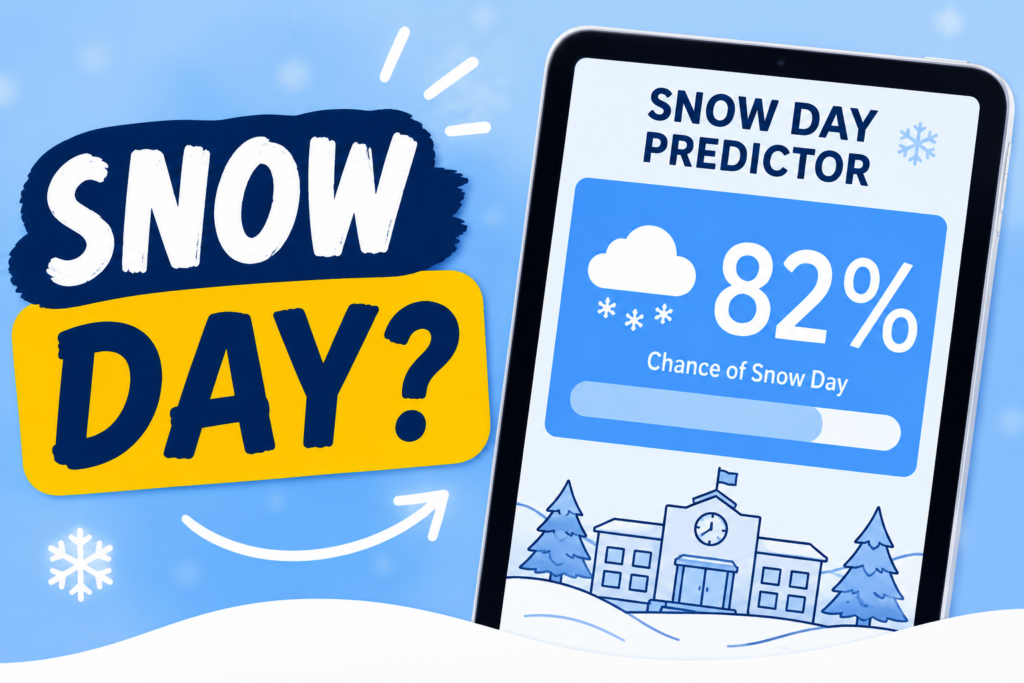
Once people understand the real blizzard vs snowstorm difference, the next question is almost always practical: is this bad enough to close school or send everyone home early? That’s usually when a snow day predictor or snow day calculator enters the search.
These tools work by taking inputs like expected snowfall totals, wind speed, temperature, and sometimes your school district’s history of closures, then spitting out a probability that classes will be cancelled. A snow day calc can be a fun, useful way to gauge the odds the night before a storm, and a good snow predictor will factor in road conditions and timing a storm that hits at 3 a.m. behaves very differently for school closures than one that peaks during the morning commute.
Here’s the honest caveat worth knowing: no snow day prediction tool, no matter how well-built, is an official source. School closures are decided by superintendents and transportation departments based on real-time road conditions, plow schedules, and local safety judgment not an algorithm. Treat a snow day calculator as an entertaining estimate to check alongside the forecast, not a replacement for your school district’s actual announcement or the National Weather Service’s official blizzard and winter storm warnings. When wind and visibility numbers start approaching true blizzard territory, that’s the point to stop relying on a predictor and start watching official alerts directly.
How to Stay Safe When Blizzard Conditions Hit
Whether a storm technically qualifies as a blizzard or just an intense snowstorm, the safety response should look the same once wind and visibility start dropping fast.
If you’re at home:
- Bring in extra firewood, flashlights, and batteries before the wind picks up — losing power mid-storm is common when heavy, wind-driven snow snaps branches and lines
- Keep a phone charged and know your local emergency alert system
- Avoid non-essential trips once visibility starts falling, even if snowfall looks moderate
If you’re driving or already on the road:
- Pull over safely and wait it out if visibility drops sharply; driving blind in a whiteout is one of the leading causes of multi-car pileups
- Keep an emergency kit in the car — blanket, extra layers, snacks, and a way to signal for help
- Never run your engine for warmth with the tailpipe blocked by snow; carbon monoxide risk rises fast in stuck, idling vehicles
A quick safety note: if local officials or the National Weather Service issue a blizzard warning, treat it as a hard stop on travel plans, not a suggestion. The three-hour, 35 mph threshold that defines an official blizzard exists precisely because those are the conditions where visibility loss and stranded vehicles become genuinely life-threatening, not just inconvenient.