
If you grew up watching your local news for school closure lists, college can feel confusing the first time snow starts falling on campus. So do colleges have snow days? The short answer is yes, but not in the way most students expect. Universities can and do close for severe weather, but they do it far less often, and far more selectively, than elementary and high schools.
Unlike K-12 systems, colleges weigh a mix of financial, logistical, and safety factors before shutting down. A single snowy morning rarely triggers a full closure. Instead, most institutions lean toward delays, remote learning switches, or leaving the decision up to individual professors which is exactly why so many students end up confused, checking their inbox and campus alert app at 6 a.m. wondering if class is actually cancelled.
In this guide, we’ll break down how college snow day policy actually works, why it differs so much from high school, how to check your school’s status in real time, and how tools like a snow day calculator or snow day predictor can help you plan ahead whether you’re studying in the US, Canada, or the UK.
Do Colleges Have Snow Days, or Is It a Myth?
It’s not a myth, but it is often misunderstood. Do colleges have snow days in the same sense as elementary schools? Not usually. Most universities try to stay open through moderate snow, sleet, or ice, only closing when conditions become genuinely dangerous, such as when roads are unsafe for buses, staff, or commuting students.
Part of this comes down to scale. A university campus houses thousands of students, many of whom live on site. Closing the entire institution affects dining halls, dorms, labs, and research facilities, not just classrooms. So while a light snowfall might cancel elementary school, that same storm often barely registers on a college campus with plowed walkways and residential housing.
That said, severe winter storms, blizzards, or dangerously low wind chills absolutely can lead to a full university closure. When this happens, schools typically notify students through:
- Campus-wide text and email alerts
- The official university website or app
- Local news broadcasts
- Social media accounts for the school
The key difference from high school is frequency. A college might only close a handful of times per decade for extreme weather, while nearby K-12 districts could close multiple times each winter for the same storm system.
Why College Snow Day Policy Is Different From K-12 Schools
The biggest reason college snow day policy looks so different from high school comes down to money and mission. Universities operate on tuition paid per credit hour, research schedules, and contractual obligations to faculty and staff. Closing campus is not just an inconvenience; it can mean lost lab time, delayed research deadlines, and rescheduling headaches across hundreds of course sections.
There is also the residential factor. Roughly half of full-time college students live on or near campus, according to national housing data. For these students, walking to class is very different from a child waiting at a bus stop in freezing temperatures. Because of this, colleges often judge conditions by walkability and road safety for staff, not just whether snow is falling.
Accreditation requirements play a role too. Many degree programs must meet a minimum number of instructional hours per semester. Too many closures can force universities to extend the semester, cut breaks short, or add makeup sessions, something administrators actively try to avoid.
How a University Closure Decision Actually Gets Made
Most schools rely on a small emergency response team, often including campus safety officials, facilities management, and senior administrators. This team monitors real time weather data, road conditions, and forecasts from local meteorologists before making a call, usually as early as possible so commuting students and staff can plan safely.
Even when the university itself stays open, individual professors often have discretion to cancel their own class if they feel conditions are unsafe or if they simply cannot make it to campus themselves. This is one of the most overlooked parts of how college closures actually work in practice.
How to Check If Your College Is Closed Today
If you’re wondering do colleges have snow days happening right now on your campus, the fastest way to find out is directly from your school, not social media rumors. Reliable sources include your university’s official closure hotline, the school’s homepage banner, your student email, and any emergency alert app you signed up for during orientation.
Most universities also maintain a dedicated weather or emergency information page that updates in real time during storms. Bookmarking this page before winter starts can save you from anxiously refreshing your inbox on a snowy morning. Campus public safety departments typically post updates there before anywhere else.
If you commute, checking your specific route matters just as much as checking the university status. A campus might stay open while your particular highway or transit line is unsafe, so many colleges also allow excused absences for students who cannot safely reach class, even without a formal closure.
Using a Snow Day Calculator or Predictor Before It Happens
Long before an official announcement, many students turn to a snow day calculator or snow day predictor to estimate the odds of a closure. These tools typically factor in snowfall totals, wind chill, ice accumulation, and your school’s historical closure patterns to generate a rough snow day prediction.
While no snow predictor is perfectly accurate since university decisions involve human judgment, not just weather data, these tools are genuinely useful for planning. Running a quick snow day calc the night before a storm can help you decide whether to prep an assignment early, adjust your commute plans, or simply set an earlier alarm to check for updates.
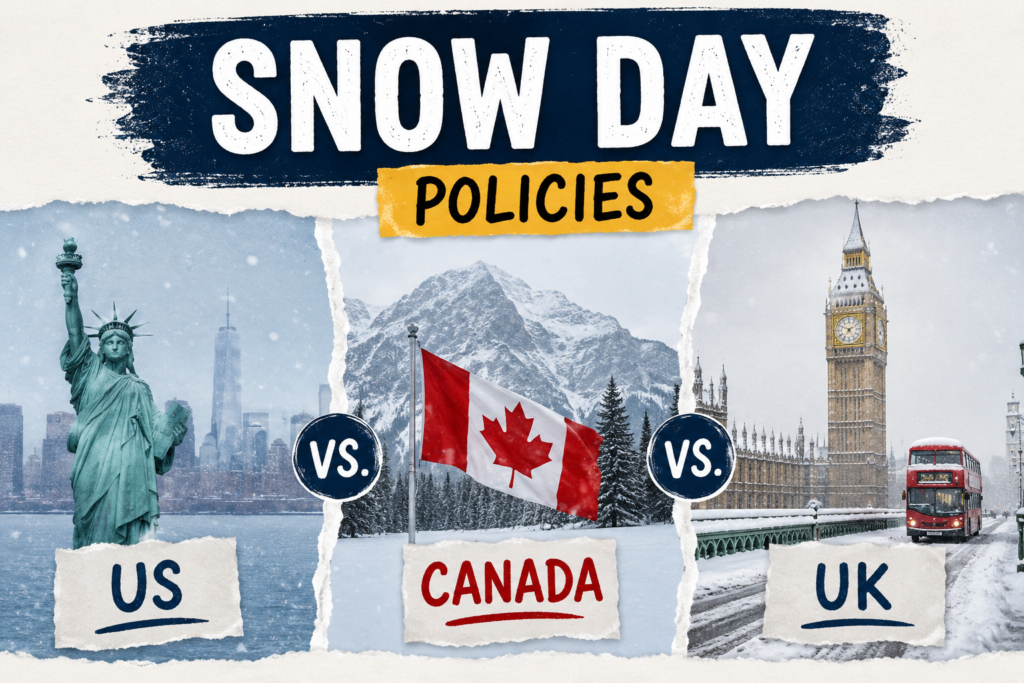
US vs. Canada vs. UK: How Snow Day Policies Compare
Winter weather habits vary widely across regions, and so does how seriously do colleges have snow days gets treated depending on where you study.
In the United States, closures depend heavily on region. A university in Minnesota or Michigan is built for snow, with plows, heated walkways, and staff experienced in icy conditions, so it takes a major storm to close campus. Meanwhile, a college in the southern US, like Texas or Georgia, may shut down for even a light dusting of snow simply because the infrastructure and driving experience for such conditions aren’t there.
Canadian universities generally follow a similar pattern to snowy US states. Institutions in provinces like Ontario or Quebec are well equipped for winter and rarely close for typical snowfall. Closures usually only happen during extreme cold warnings, ice storms, or blizzard level conditions that make travel genuinely dangerous, not just inconvenient.
In the United Kingdom, the picture looks quite different. Snowfall heavy enough to disrupt daily life is rarer and less predictable, so British universities and transport systems aren’t built around snow management the way North American ones are. When snow does hit hard, UK campuses are actually more likely to close, since even a few inches can shut down local roads, trains, and buses that students rely on to get to campus.
This regional gap explains why a blanket answer to whether colleges close for snow rarely works. Local infrastructure and weather familiarity matter far more than the amount of snowfall itself.
What To Do When Your College Does Announce a Snow Day
Once you’ve confirmed your university is actually closed, the next step is knowing what to expect. Class cancellations rarely mean a free pass on coursework. Many professors shift to remote instruction, extend assignment deadlines slightly, or simply pick up where they left off at the next session. Since do colleges have snow days so infrequently compared to K-12 schools, faculty usually have a plan ready for exactly this scenario rather than treating it as a total disruption.
If your school switches to a remote learning day instead of a full closure, treat it like a real class. Log in on time, keep your camera on if required, and stay engaged just as you would in person. This shift became far more common after 2020, and many universities now default to remote instruction during moderate storms instead of cancelling class outright, which is worth understanding since it changes what a “snow day” actually looks like on a modern campus.
Above all, prioritize safety over perfect attendance. If your university stays open but you genuinely cannot travel safely, reach out to your professor or academic advisor as early as possible. Most institutions have documented absence policies for exactly this situation, and being proactive protects your grades far more than trying to push through unsafe conditions. Understanding college snow day policy ahead of time, rather than during a panic at 6 a.m., is the best way to stay prepared no matter where you study.
Frequently Asked Questions
Do colleges have snow days like high schools?
Not usually. Do colleges have snow days is a common question, but universities close far less often than K-12 schools. Colleges typically only cancel classes during severe storms, ice, or dangerously low wind chills, relying instead on delays or remote learning days for lighter snowfall.
How do I know if my college has a snow day today?
Check your university’s official website, emergency alert app, or student email first. These sources update in real time and are far more reliable than social media rumors during a storm.
What is a typical college snow day policy?
Most schools follow a college snow day policy that involves an emergency response team reviewing weather data, road conditions, and campus walkability before deciding on a closure, delay, or remote learning switch.
Can professors cancel class even if the university stays open?
Yes. Many professors have individual discretion to cancel or move their class online if they feel conditions are unsafe, even when the broader university closure hasn’t been announced.
Are snow day calculators accurate for colleges?
A snow day calculator or snow day predictor can offer a useful snow day prediction based on forecasted snowfall and historical closure patterns, but since university decisions involve human judgment, no snow predictor or snow day calc guarantees accuracy.