
Every winter, the same scene plays out in kitchens across the US, Canada, and the UK: a phone buzzes at 5 a.m., and parents scramble to find out if school is actually happening. If you’ve ever wondered exactly how do schools decide snow days, the honest answer is that it’s rarely just about how much snow fell overnight. Superintendents, transportation directors, and facilities staff weigh road conditions, temperature, timing, and even bus route geography before making the call. This guide breaks down the real decision-making process: who’s involved, what they check, and why two districts can look at the same storm and reach opposite conclusions.
Who Actually Makes the Snow Day Decision
Despite what many parents assume, how do schools decide snow days doesn’t come down to one person sitting behind a desk. In most US and Canadian districts, it’s a small team: the superintendent makes the final call, but that call is built on input from several people working before sunrise. Transportation directors are usually first in the chain. They drive or send crews to drive actual bus routes starting as early as 4 a.m., checking for ice patches, unplowed side streets, and visibility. Facilities managers report on parking lot and sidewalk conditions at school buildings themselves, since buses aren’t the only safety concern. Many superintendents also call neighboring districts to compare notes, because a shared regional forecast doesn’t always translate into identical local road conditions.
In the UK, the structure looks a bit different. Individual head teachers typically decide school closures independently, without a district-wide chain of command, which is why it’s common to see one UK school close while another a few miles away stays open. Canadian districts often sit somewhere in between school boards make the call, but it’s frequently framed as a “bus cancellation” rather than a full closure, meaning buses don’t run but the building may still be open for students who can get there safely. What all three systems share is the same underlying goal: nobody wants to make the decision, but everybody wants it made early enough for families to plan around it
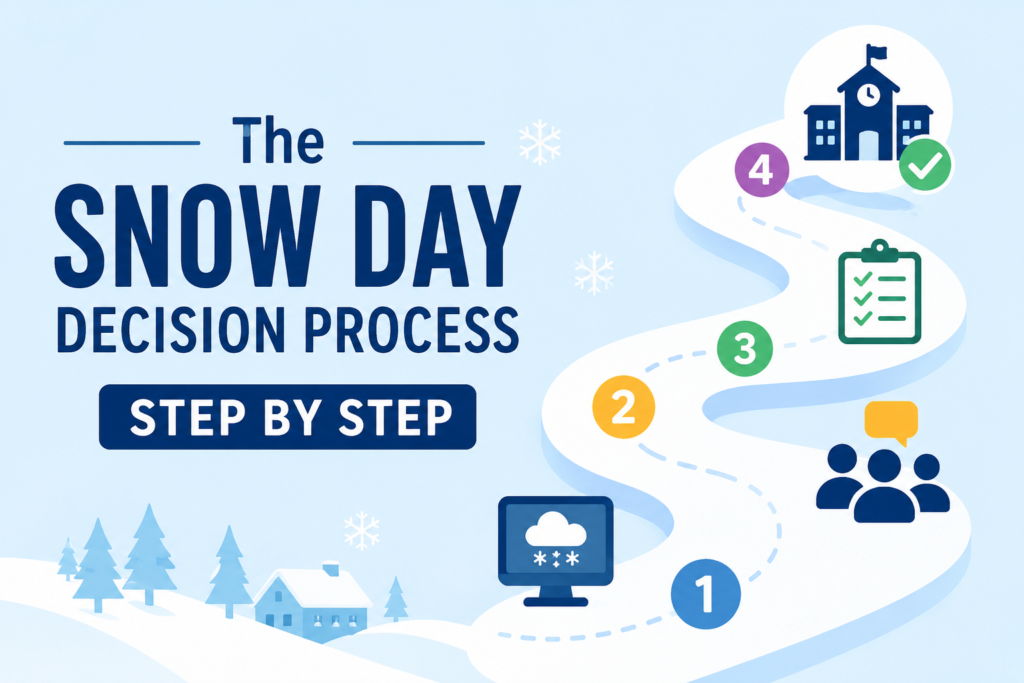
The Snow Day Decision Process: How Do Schools Decide Snow Days Step by Step
The snow day decision process rarely happens in one single moment. It’s more like a rolling checklist that starts the evening before a storm and doesn’t end until the final call goes out, sometimes as late as 5:30 or 6 a.m.
What Happens the Night Before
If a major storm is forecast with high confidence say, a foot of snow expected overnight, some districts will announce a closure the evening before, often between 8 p.m. and midnight. This early call is reserved for storms that are essentially guaranteed, since districts are cautious about canceling too soon and then watching the storm fizzle out. Superintendents describe this stage as checking the forecast obsessively in the days leading up to it, without committing to anything until the picture is clear.
The Early-Morning Road Check
More often, especially when snowfall timing is uncertain, the real decision happens between 4 a.m. and 6:30 a.m. This is when transportation staff are physically out on roads, and when districts get their most accurate read on overnight accumulation, ice formation, and plow progress. It’s also when neighboring districts compare notes before anyone announces anything publicly. This step-by-step approach explains why how do schools decide snow days so often comes down to a pre-dawn judgment call rather than a forecast made days in advance.
The Real School Closure Criteria Districts Use
There’s no single national rulebook no fixed “2 inches equals a snow day” formula. Instead, most districts rely on a set of school closure criteria that get weighed together, not judged in isolation.
Snowfall Rate, Ice, and Wind Chill
How fast snow falls often matters more than the total amount and it’s one of the clearest examples of how do schools decide snow days beyond just watching a snowfall total. Plow crews can generally keep pace with moderate snowfall, but when accumulation exceeds roughly an inch per hour, roads can become unsafe faster than crews can clear them, even if the storm’s total is otherwise manageable. Ice is treated even more seriously than snow, since a thin glaze on roads and sidewalks is far more dangerous for buses and pedestrians than several inches of dry powder.
Temperature plays its own role, separate from snowfall. Extreme cold often below 0°F (-17°C) with wind chill factored in can trigger a closure even on a clear day, since young children waiting at bus stops face real frostbite risk. Wind is a factor too: strong gusts can cause whiteout conditions on open roads, cutting visibility to a few hundred feet even after snow has stopped falling. One detail most parents never think about: heavy snowbanks can physically narrow streets to the point where two buses can’t safely pass each other. This “clearance” issue is why some districts stay closed a day after snow has stopped, once plowing catches up. Because these factors are combined differently depending on a district’s terrain, number of rural routes, and available plow crews, identical snowfall totals can lead to completely different decisions in neighboring towns which is really the heart of how do schools decide snow days the way they do.
Can a Snow Day Calculator Actually Predict Closures?
Given how many variables go into a real district decision, it’s no surprise that a snow day calculator has become a go-to tool for anxious parents and students trying to guess how do schools decide snow days before any official word comes out. These tools typically ask for your ZIP code or district, then estimate closure odds using forecasted snowfall, temperature, and wind data. It’s worth being honest about what a snow day predictor can and can’t do.
It can approximate the same inputs superintendents look at snowfall rate, ice risk, wind chill and turn them into a rough probability. What it can’t do is know your district’s specific plow schedule, how many rural bus routes it covers, or whether your superintendent tends to be cautious or reluctant to close school. That’s why a snow predictor should be treated as a helpful estimate the night before, not a guarantee. Used correctly, a snow day calc is most reliable when you check it twice: once the evening before to gauge overall storm severity, and again early the next morning once actual overnight totals and road conditions are known.
The gap between those two numbers often mirrors exactly what district officials are doing in real time refining their read on the storm as new data comes in rather than trusting a forecast from days earlier. If your area’s snow day prediction looks borderline say, a 40–60% chance that’s usually a signal the decision genuinely could go either way, and reflects just how localized how do schools decide snow days really is. It’s worth checking your district’s official communication channel rather than relying on the calculator alone.
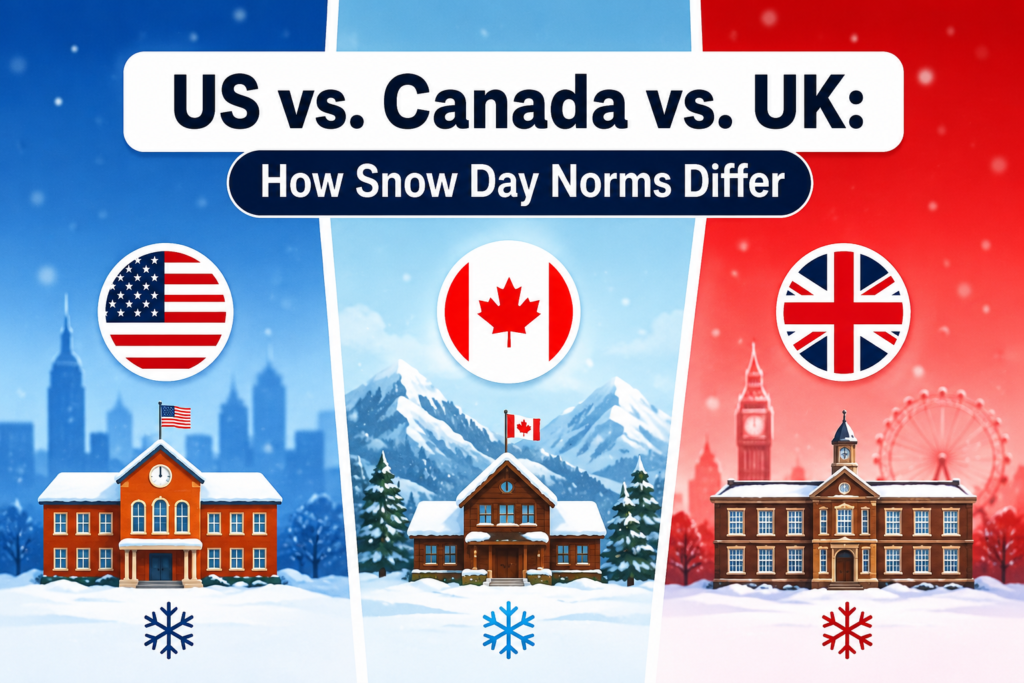
US vs. Canada vs. UK: How Snow Day Norms Differ
Because this topic spans several countries, it’s worth spelling out how differently “snow day” plays out depending on where you live.
In the US, snow days are a well-established tradition, especially across the Midwest, Northeast, and Mountain states. Some districts have shifted toward remote learning on snow days instead of full closures, though many parents and educators have pushed back, arguing that kids benefit more from an actual break than a Zoom call during a storm.
In Canada, the language shifts slightly. Many school boards use “bus cancellations” rather than outright closures buses stay off the road for safety, but schools often remain open for students who can get there independently. This distinction matters because it means a “no buses” day isn’t always the same as a full snow day, which can confuse families new to the system.
In the UK, snow days are comparatively rare and far less standardized. Because heavy snowfall is less frequent and infrastructure isn’t built around it the same way, even a few centimeters can prompt closures but the decision is typically made by individual head teachers rather than a district-wide office. This is why it’s common to see schools a short distance apart make completely different calls during the same storm. Understanding these regional differences matters if you’re checking closure information for family in another country, since the terminology and decision structure genuinely aren’t the same.
FAQs
How do schools decide snow days, in one sentence?
Districts combine overnight snowfall forecasts, real-time road checks, ice risk, and wind chill, then a superintendent (or head teacher in the UK) makes the final call, usually between 4 a.m. and 6:30 a.m.
What time are snow day announcements usually made?
Most decisions land in one of two windows: the night before (8 p.m.–midnight) for storms that are all but guaranteed, or early morning (4 a.m.–6:30 a.m.) once road crews have assessed actual conditions.
Do schools use a set number of inches to decide?
No. There’s no universal threshold. School closure criteria vary by district based on terrain, number of bus routes, and available plow crews which is why identical snowfall totals can produce different decisions in neighboring towns.
Is a snow day calculator accurate?
It’s a useful estimate, not a guarantee. A snow day calculator can model the same weather inputs districts use, but it can’t account for your specific district’s plow schedule or how cautious your superintendent tends to be.
Why does one district close and the next stay open?
This comes back to the core of how do schools decide snow days: it’s a local judgment call based on that district’s roads, bus fleet, and terrain not a regional weather threshold everyone follows equally.