Snow Day Predictor | Accurate School Closure Forecast
AI-powered predictions using live weather data & real-time storm analysis
⚠️ Accuracy Notice: Our AI-powered system delivers up to 98% prediction accuracy using live weather data, district history, and real-time storm analysis. Results are based on advanced forecasting models and continuously updated weather insights.
Winter weather can create uncertainty for students, parents, and school staff, especially in regions where heavy snowfall regularly disrupts daily routines. In states such as Alaska, weather conditions can change rapidly overnight, making it difficult to know whether schools will remain open the next morning. This is where a snow day predictor in Alaska becomes a valuable planning tool. Rather than relying on rumors, social media updates, or general weather forecasts, a snowday predictor analyzes multiple weather-related factors to estimate the likelihood of school cancellations or delays. By combining snowfall forecasts, temperature data, road conditions, and storm timing, these tools provide a clearer picture of potential disruptions before official announcements are released.
Modern prediction systems go beyond simple weather reports. They evaluate how local conditions may affect transportation, school operations, and public safety. This allows families to make informed decisions, prepare for changing conditions, and reduce uncertainty during severe winter weather events. Whether you live in Alaska, another northern U.S. state, or a region that experiences seasonal snowstorms, understanding how school closure forecasting works can help you stay one step ahead when winter weather arrives.
What is a Snow Day Predictor?
A snow day predictor is an online forecasting tool designed to estimate the likelihood of school closures, delays, or schedule changes caused by winter weather. Instead of simply showing a weather forecast, it evaluates how weather conditions may affect local schools and transportation systems. The goal is to provide families with an early indication of whether classes are likely to be canceled before official district announcements are released. Unlike standard weather apps that focus on temperature, snowfall totals, and precipitation, a school closure predictor looks at how those conditions impact real-world travel and safety. School administrators often consider road conditions, visibility, ice accumulation, wind chill, and bus route safety when making closure decisions. A forecasting system attempts to model these same factors to estimate potential outcomes.
Modern snow day prediction tools use a combination of weather forecasts, historical trends, and location-specific conditions. By comparing current storm forecasts with previous winter events, they can identify patterns that frequently lead to school cancellations. This approach helps generate a realistic estimate rather than a simple guess. One of the most useful features of these tools is the ability to calculate snow day probability based on a user’s location. Since weather conditions can vary dramatically across Alaska, even within neighboring communities, localized forecasting plays an important role in improving prediction accuracy.
For example, a storm producing six inches of snow in one area may have little impact if roads are well maintained, while a smaller storm combined with ice and strong winds may create conditions severe enough to close schools. Because of these regional differences, modern forecasting systems focus on local impact rather than snowfall totals alone. As winter forecasting technology continues to improve, these tools provide a practical way for parents, students, and educators to prepare for potentially disruptive weather before official decisions are announced.
How a Snow Day Predictor Calculates School Closure Chances
A modern snow day predictor does much more than monitor snowfall forecasts. Behind the scenes, it functions as an AI-powered prediction system that evaluates multiple weather variables and compares them with historical school closure outcomes. The objective is to estimate how likely schools are to cancel classes based on current and expected weather conditions. The process typically begins with collecting forecast information from trusted weather sources. This includes snowfall accumulation, temperature changes, wind speed, freezing rain risk, visibility levels, and road conditions. The system then analyzes how these conditions may affect transportation routes, student safety, and school operations.
Many advanced platforms also use years of school closure pattern data to improve forecasting accuracy. By studying previous winter storms and the decisions made by school districts under similar circumstances, the system can identify patterns that frequently lead to closures or delays. This historical comparison helps generate more realistic estimates than relying on weather forecasts alone. An AI-powered prediction calculator continuously updates as new weather information becomes available. If a storm changes direction, temperatures drop faster than expected, or ice begins developing on roads, the forecasted closure chances can adjust accordingly. This dynamic approach allows predictions to reflect the latest conditions rather than outdated weather models.
In Alaska, a snow day predictor becomes even more important because winter weather can vary significantly from one community to another. Coastal areas may experience mixed precipitation, while inland regions often deal with extreme cold, blowing snow, and rapidly changing visibility. A location-specific forecasting model can account for these differences and produce more reliable estimates. The final prediction generated by a snow day predictor alaska is usually presented as a percentage that reflects the estimated likelihood of cancellation. While no forecasting tool can guarantee a school closure, analyzing weather conditions alongside historical trends provides a practical way to estimate potential disruptions before official announcements are released. As forecasting technology continues to evolve, predictive systems are becoming increasingly effective at helping families prepare for winter weather and make informed decisions ahead of the school day.
Weather Factors That Have the Biggest Impact on School Closures
Not all winter storms affect schools in the same way. While many people assume snowfall totals are the primary reason for cancellations, school districts evaluate several weather-related factors before deciding whether students and staff can travel safely. Understanding these conditions can help explain why the snow day percentage sometimes increases even when snowfall amounts appear moderate.
Snowfall Accumulation and Storm Timing
Heavy snowfall remains one of the most common causes of school closures. However, timing often matters just as much as total accumulation. A storm that delivers several inches of snow overnight may be easier to manage than a storm that intensifies during the morning commute. When snow continues falling during bus pickup hours, road crews may struggle to keep streets clear. This often increases the estimated snow day probability or snow day chances because transportation becomes more difficult and hazardous.
Ice and Freezing Rain
Among all winter weather hazards, ice is often considered the most dangerous. Even a thin layer of ice can create unsafe driving conditions for buses, parents, and school staff. During severe freezing rain scenarios, roads, sidewalks, and parking lots can become hazardous within a short period of time. Because ice is difficult to treat quickly, many districts choose to delay or cancel classes even when snowfall totals remain relatively low. This is one reason why forecasting systems place significant weight on freezing rain predictions.
Wind, Blowing Snow, and Visibility
Strong winds can dramatically increase the impact of a winter storm. In many parts of Alaska, blowing snow creates visibility problems that make travel dangerous even after roads have been plowed. Whiteout conditions can develop when wind lifts loose snow from the ground and reduces visibility to only a few feet. A snow day predictor often considers these conditions a major risk factor because school districts prioritize safety for buses traveling on rural routes and remote highways.
Extreme Cold and Wind Chill
Temperature also plays an important role in closure decisions. Extremely low temperatures combined with strong winds can create dangerous wind chill values. Students waiting at bus stops or walking to school may face increased risks of frostbite and exposure during prolonged periods outdoors. This factor becomes especially important in Alaska, where winter temperatures can remain well below freezing for extended periods. A snow day predictor often incorporates temperature and wind chill data to better estimate the likelihood of school closures during severe cold-weather events.
Road Conditions and Local Infrastructure
The same storm can produce different outcomes depending on the community. Areas with extensive snow removal resources may continue operating normally, while smaller communities may require additional time to clear roads and ensure safe travel conditions. For this reason, a snow day predictor alaska evaluates multiple weather variables together rather than focusing on a single measurement. By considering snowfall, ice, wind, temperature, and road conditions simultaneously, prediction systems can provide a more realistic estimate of potential school disruptions.
Why Alaska Needs Hyperlocal Snow Day Forecasting
Alaska experiences some of the most diverse winter weather conditions in North America. A single statewide forecast is often not enough to determine whether schools will remain open because weather patterns can vary significantly between regions. This is why modern forecasting platforms rely on hyperlocal weather analysis rather than broad regional predictions.
In many states, weather conditions remain relatively consistent across large areas. Alaska is different. Coastal communities may experience wet snow, freezing rain, or mixed precipitation, while inland areas can face extreme cold, heavy snowfall, and strong winds at the same time. A storm affecting Anchorage may produce completely different conditions than one impacting Fairbanks, Juneau, or smaller rural communities. Because of these differences, an accurate snow day predictor requires location-specific weather data. Modern prediction systems analyze local forecasts, road conditions, temperature trends, and storm timing to generate estimates that are relevant to a particular community rather than an entire state.
Another challenge is Alaska’s unique transportation network. Many students travel long distances, while some communities have limited road infrastructure compared to major metropolitan areas. In remote regions, even moderate snowfall can create disruptions that would have little impact elsewhere. These local factors influence how school districts respond to winter weather and why a snow day predictor must account for regional differences. Many forecasting platforms provide US & Canada snow day predictions, allowing users to receive estimates across different locations. While broad coverage is useful, the most accurate forecasts typically come from systems that focus on local conditions and district-specific weather impacts.
A quality prediction platform also works for US and Canada / location-based prediction (Alaska) by adjusting forecasts according to regional weather patterns rather than applying a one-size-fits-all model. This localized approach helps improve accuracy because winter storms behave differently across northern climates. Ultimately, school closure forecasting becomes more reliable when predictions are built around local weather conditions instead of statewide averages. By focusing on community-level data, forecasting systems can provide families with more relevant information and a better understanding of how upcoming winter weather may affect the next school day.
How to Use a Snow Day Predictor Effectively
Getting the most accurate results from a snow day predictor requires more than checking a percentage once and moving on. Weather conditions can change quickly, especially during active winter storms, which is why understanding how to use a prediction tool correctly can help you make better decisions. The first step is to perform a zip code snow day check using your exact location. Local weather conditions often vary between neighboring communities, so a forecast generated for your specific area is usually far more reliable than a regional forecast.
Most forecasting platforms allow users to enter your zip code to see the chances of a snow day tomorrow school cancellation or delay. Once the location is selected, the system analyzes current forecasts, weather trends, and local conditions to generate an estimated closure probability. After receiving the prediction, take a moment to review the factors influencing the forecast. A strong snow day predictor alaska does more than display a percentage. It helps users understand whether snowfall, ice accumulation, wind, visibility, or extreme temperatures are contributing to the estimate.
It is also important to check school closures using real weather data rather than relying solely on social media discussions or unofficial reports. Forecasting tools that continuously update weather information can provide a more accurate picture of changing conditions throughout the day. Another best practice is to revisit the forecast later in the evening. Many winter storms become clearer as new weather models are released, and predictions update in the evening when forecasters gain additional confidence in storm tracks and snowfall totals. Checking again before bedtime often provides a better indication of what may happen the following morning.
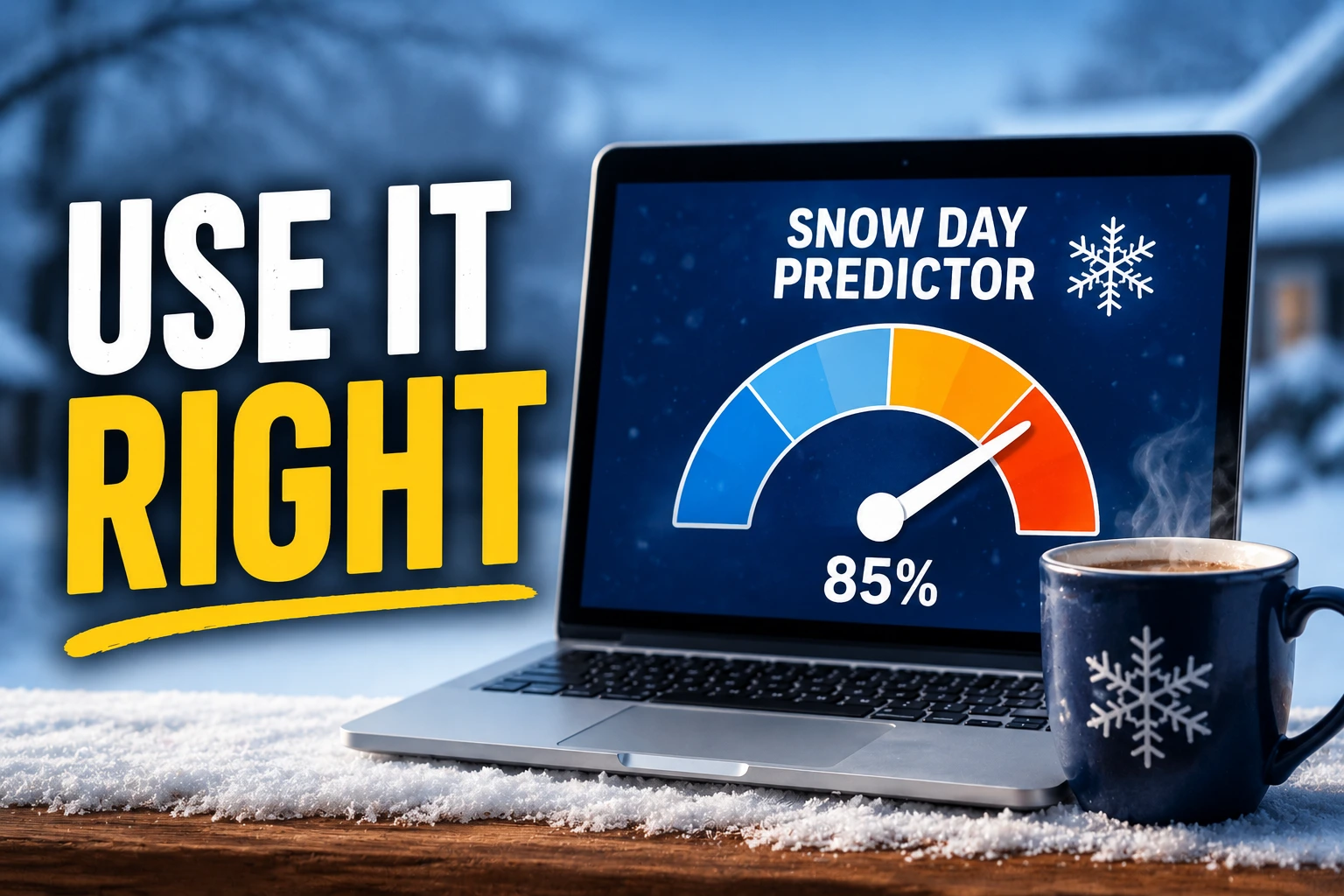
| Step | Action | Purpose |
|---|---|---|
| 1 | Enter your ZIP code | Generate location-specific results |
| 2 | Review the prediction percentage | Understand estimated closure risk |
| 3 | Check weather factors | Identify what is driving the forecast |
| 4 | Recheck during evening updates | Monitor forecast changes |
| 5 | Confirm official announcements | Verify final district decisions |
Although prediction tools can be highly useful, a snow day predictor should always be viewed as a planning resource rather than an official source. School districts make final decisions based on real-time conditions, operational considerations, and safety assessments that may not be fully reflected in a forecast model.
When used correctly, a forecasting tool can help parents, students, and educators prepare ahead of time and reduce uncertainty during challenging winter weather events.
Snow Day Predictor vs Snow Day Calculator: What's the Difference?
Many people use the terms prediction tool and calculator interchangeably, but there are important differences between the two. Understanding how each system works can help users choose the most reliable option when preparing for potential school cancellations during winter weather. A traditional Snow Day Calculator is typically designed to generate an estimated closure percentage based on a limited set of weather inputs. Earlier versions often relied on user-entered information such as snowfall totals, temperature, and location. While these tools can provide a quick estimate, their accuracy depends heavily on the quality of the information being entered.
A modern snow day predictor, on the other hand, operates more like an intelligent prediction system. Instead of relying solely on manual inputs, it continuously analyzes weather forecasts, changing storm conditions, local infrastructure factors, and historical closure trends. This creates a more dynamic forecast that adjusts as new weather information becomes available. Another key difference is the level of detail provided. Basic calculators often focus on producing a percentage, while advanced weather analysis tool or forecasting tools explain why closure risks are increasing or decreasing. This additional context helps users understand the factors influencing school operations rather than simply viewing a number on the screen.
As forecasting technology evolves, many users now prefer systems that provide an Accurate School Closure Forecast by combining weather intelligence with historical decision-making patterns. These platforms are especially useful in regions with complex winter weather, where small changes in temperature or precipitation can significantly alter travel conditions. The latest generation of tools, including solutions commonly referred to as Snow Day Calculator 2026, place a stronger emphasis on real-time forecasting and localized weather analysis.Rather than offering a static estimate, a snow day predictor adapts throughout the day as weather models are updated and new observations become available.
| Feature | Traditional Calculator | Modern Prediction System |
|---|---|---|
| Manual weather inputs | Common | Rarely required |
| Real-time forecast updates | Limited | Yes |
| Historical closure analysis | Basic | Advanced |
| Localized forecasting | Moderate | High |
| Weather impact explanations | Minimal | Detailed |
| Forecast adaptability | Low | High |
Common Reasons Schools Close During Winter Weather
School districts evaluate a wide range of safety and operational factors before deciding whether classes should be canceled or delayed. While heavy snowfall often receives the most attention, it is rarely the only reason schools close. In many cases, a snow day predictor Alaska analyzes multiple weather-related concerns that combine to create conditions that make normal operations difficult or unsafe.
Hazardous Road Conditions
Road safety is one of the most important factors considered by school officials. Even when snowfall amounts are moderate, untreated roads can become dangerous for buses, parents, and staff. Slippery intersections, icy bridges, and reduced traction increase the risk of accidents during the morning commute.
For districts that serve large geographic areas, a snow day predictor can help evaluate road conditions across multiple communities before a final decision is made, providing a more accurate estimate of potential school disruptions.
Ice Accumulation
Ice is frequently more disruptive than snow. A small amount of freezing rain can create hazardous travel conditions within minutes. Sidewalks, parking lots, school entrances, and bus routes may become unsafe, making transportation and pedestrian travel difficult.
Because ice is harder to remove quickly than snow, many districts take a cautious approach when significant icing is expected.
Low Visibility and Blowing Snow
Strong winds can significantly increase the impact of a winter storm. Blowing snow may reduce visibility on highways and rural roads, making it difficult for bus drivers and other motorists to travel safely.
In Alaska and other northern regions, whiteout conditions occasionally develop when wind-driven snow reduces visibility to near zero. Under these circumstances, a snow day predictor often identifies elevated closure risks, as schools prioritize safety by delaying or canceling classes.
Extreme Cold and Wind Chill
Temperature plays an important role in school closure decisions, particularly in colder climates. Prolonged exposure to dangerously low temperatures can increase the risk of frostbite and other cold-related injuries.
Students waiting outdoors for transportation may face additional risks when strong winds combine with subfreezing temperatures. In some cases, a snow day predictor may indicate an increased likelihood of school closures / school being closed tomorrow even when snowfall is minimal because extreme cold creates unsafe conditions.
Transportation and Staffing Challenges
Weather impacts more than just roads. School districts must also consider whether teachers, support staff, and transportation personnel can safely reach their workplaces.
A district may decide to close schools if large numbers of employees are unable to travel due to storm conditions. Similarly, transportation departments may face challenges operating bus routes when weather deteriorates rapidly. A snow day predictor often considers these operational factors alongside weather conditions to provide a more realistic estimate of potential school closures.
Power and Facility Issues
Severe winter storms can sometimes damage power lines or disrupt heating systems. Schools require reliable electricity, lighting, communications, and heating to operate safely.
If a building cannot maintain a safe indoor environment, administrators may choose to cancel classes until conditions improve and facilities can be properly restored.
Why Closure Decisions Vary Between Districts
One of the most common questions families ask is why neighboring districts sometimes make different decisions during the same storm. The answer often comes down to local circumstances. Factors such as road maintenance resources, bus route length, population density, terrain, and weather intensity can differ significantly from one district to another. As a result, a snow day predictor may estimate a higher closure risk for one community while showing a lower probability for another located only a short distance away.
Understanding these factors helps explain why a snow day predictor Alaska focuses on overall impact rather than snowfall totals alone. School closure decisions involve safety, transportation, infrastructure, and operational considerations that extend far beyond the weather forecast itself.
Ultimately, both tools serve the same purpose: helping families prepare for possible school disruptions. However, systems that combine live weather information, historical trends, and location-specific forecasting generally provide more useful guidance when winter weather creates uncertainty.
Snow Day Predictor — All Cities
Click any city for its dedicated snow day calculator page — powered by real-time weather data.
Frequently Asked Questions
A snow day predictor can provide a useful estimate of potential school closures by analyzing weather forecasts, local conditions, and historical trends. However, no forecasting tool can guarantee a cancellation because final decisions are made by individual school districts based on real-time safety assessments.
While there is no universal threshold, many people consider a forecast above 70% to represent a strong possibility of a school closure. Actual outcomes can still vary depending on local road conditions, district policies, and changing weather forecasts.
Yes. Many winter-related closures occur because of ice accumulation, freezing rain, dangerous wind chills, poor visibility, or transportation concerns. In some situations, these factors can create greater risks than snowfall itself.
Forecasting tools can be particularly useful in Alaska when they incorporate localized weather data and regional forecasting models. Because weather conditions vary significantly across the state, location-specific predictions generally provide more accurate estimates than statewide forecasts.
It is usually best to review forecasts at least twice before a potential storm event. Many users check conditions during the evening and then again early the following morning because forecast confidence often improves as additional weather data becomes available.
The final decision is typically made by school district administrators, superintendents, or local education officials. They consider weather forecasts, road conditions, transportation safety, staffing availability, and facility operations before announcing closures or delays.
Conclusion
Winter weather can create uncertainty for families, students, and educators, especially in regions where changing conditions can affect transportation and school operations with little warning. A snow day predictor provides a practical way to prepare for these situations by analyzing weather forecasts, local conditions, and historical closure patterns to estimate the likelihood of delays or cancellations.
Unlike basic weather reports, modern forecasting tools focus on how winter storms impact daily life. By evaluating factors such as snowfall, ice accumulation, wind, visibility, road safety, and extreme temperatures, these systems offer a clearer understanding of potential disruptions before official announcements are made. This is particularly valuable in Alaska, where weather conditions can vary significantly between communities. A localized forecasting approach helps provide more relevant information by focusing on the conditions that matter most in a specific area rather than relying on broad regional forecasts.
Although no prediction system can guarantee whether schools will close, these tools can help families make informed decisions and plan ahead with greater confidence. Checking forecasts regularly, monitoring evening updates, and staying informed through official district communications remain the best ways to prepare for severe winter weather. When used responsibly, a snow day predictor alaska becomes more than just a forecasting tool. It serves as a valuable planning resource that helps reduce uncertainty, improve preparedness, and provide early insight into possible school disruptions throughout the winter season.